

How to Guide Yoga Nidra: Bringing the Practice to Life
What Brings Yoga Nidra to Life?
At its heart, Yoga Nidra is a luminous practice of deep rest and renewal—an invitation to turn inward, connect with our innate wholeness, and experience the simple joy of being.
For those of us who share Yoga Nidra with others, learning to guide the practice is an ongoing exploration. A thoughtfully crafted script can offer a beautiful pathway—providing structure, language, inspiration, and a carefully considered journey through the practice.
And as our own understanding of Yoga Nidra grows, so too does our capacity to bring those words to life with greater intention.
We begin to understand not only what we are offering, but why. We become more familiar with the structure and purpose of the practice, the possibilities within each stage, and the ways language, sequencing, pacing, silence, and presence can shape the experience.
Over time, Yoga Nidra becomes more than something we know how to guide. It becomes a practice we know from within.
Understanding the Why Behind the Practice
Learning to guide Yoga Nidra includes understanding its underlying framework: the stages of the practice, the purpose each can serve, how they relate to one another, and the many possibilities within them.
This framework gives us a foundation from which we can make thoughtful choices about sequencing, language, pacing, imagery, and silence.
Why might we begin by settling and orienting to the practice? What is the purpose of bringing awareness through the body or breath? How might sankalpa, imagery, awareness of sensation, or periods of spaciousness serve the larger journey? Why might one sequence be appropriate for a particular practice, while another offers something different?
When we understand the intention behind what we are guiding, the structure begins to feel less like a series of steps and more like an integrated journey.
This understanding doesn't require us to abandon a script. Instead, it can deepen the way we relate to the words in front of us.
We can recognize where there may be room for silence. We can feel the rhythm of a sequence. We can understand why a particular invitation is there and allow its purpose to inform the way we offer it.
The script continues to provide a pathway. Our understanding helps us walk that pathway with greater awareness.
The Art of Guiding Yoga Nidra
The words we choose matter, but so does the way we offer them.
Pacing can give an experience room to unfold. Silence can allow students to encounter what words cannot convey. Tone and cadence can support ease and steadiness. Clear, intentional language can invite awareness without requiring a particular response.
And presence matters.
Guiding Yoga Nidra isn't about creating a specific experience for someone else. We cannot know exactly what is happening within another person's inner landscape—and we don't need to.
Our role is to offer a thoughtful framework for exploration and create conditions that support students in meeting their own experience.
This is one of the subtleties of guiding Yoga Nidra: learning when to offer language and when to leave space, when to follow a familiar structure and when adaptation may be helpful, and how to guide with both clarity and openness.
These are skills that deepen over time.
A Framework Gives Us Room for Possibility
A clear framework does not make our teaching rigid. It gives us a foundation from which to teach with greater freedom.
When we understand both the structure of Yoga Nidra and the purpose of its different elements, we are better equipped to make intentional choices within the practice—to follow a trusted script as written, personalize an existing practice, or create a practice of our own.
A Yoga Nidra offered at the end of a yoga class may have a different rhythm or emphasis than one offered during a retreat. A brief practice may ask us to distill a sequence to its essential elements, while a longer practice gives us room to explore more fully. A private student may have different needs from a large group.
The more we understand the framework, the more thoughtfully we can consider duration, intention, language, imagery, sequencing, and the needs of the people we are guiding.
Rather than adapting simply for the sake of making something different, we can make choices in service of the practice and the students before us.
Meeting Students Where They Are
There is no single way a person experiences Yoga Nidra.
One student may move quickly into deep stillness. Another may remain aware of sounds in the room. Someone may feel restless, emotional, spacious, sleepy, peaceful, distracted, or deeply present.
All of these experiences can be part of practice.
This is why choice, agency, accessibility, and respect for each person's experience are so important in the way we guide.
We can offer invitations rather than assumptions. We can create opportunities for students to adjust their position, redirect their attention, allow an invitation to pass, or relate to an element of the practice in a way that feels appropriate for them.
Meeting students where they are does not mean anticipating or controlling everything that might arise. It means remembering that the practice belongs to the practitioner.
As teachers, we offer the container, the guidance, and the invitation. Each student meets Yoga Nidra through their own inner landscape.
Our Own Practice Becomes Part of Our Teaching
Perhaps one of our greatest teachers of Yoga Nidra is Yoga Nidra itself.
We can study its philosophy. We can learn its framework. We can explore the science of deep rest and the relationship between body, breath, mind, and awareness. We can study language, sequencing, and the many ways a practice can be adapted.
And then we practice.
Through our own experience, concepts that once lived primarily in the intellect can gradually become something we recognize from within.
We become familiar with the movement between effort and ease, attention and spaciousness, words and silence. We experience the practice differently from day to day, reminding us that our students will, too.
We don't need to understand everything fully in order to benefit from Yoga Nidra or to continue learning from it. Part of the beauty of the practice is that our relationship with it can continue to deepen.
And as it does, our personal practice naturally begins to inform our teaching—not because there is one perfect way to guide Yoga Nidra, but because we are increasingly guiding something we ourselves have come to know.
Bringing Yoga Nidra to Life
So, what brings Yoga Nidra to life?
There may not be one answer.
It can be a thoughtfully crafted script and the wisdom woven through its words. It can be our understanding of the purpose and possibilities within the practice. It can be thoughtful sequencing, intentional language, silence, pacing, and presence. It can be our willingness to meet students where they are and trust their capacity to participate in their own practice.
And it can be the relationship with Yoga Nidra that we continue to cultivate ourselves.
Together, these elements allow us to guide with greater intention while honoring both the integrity of the practice and the uniqueness of the person experiencing it.
The Heart of Yoga Nidra
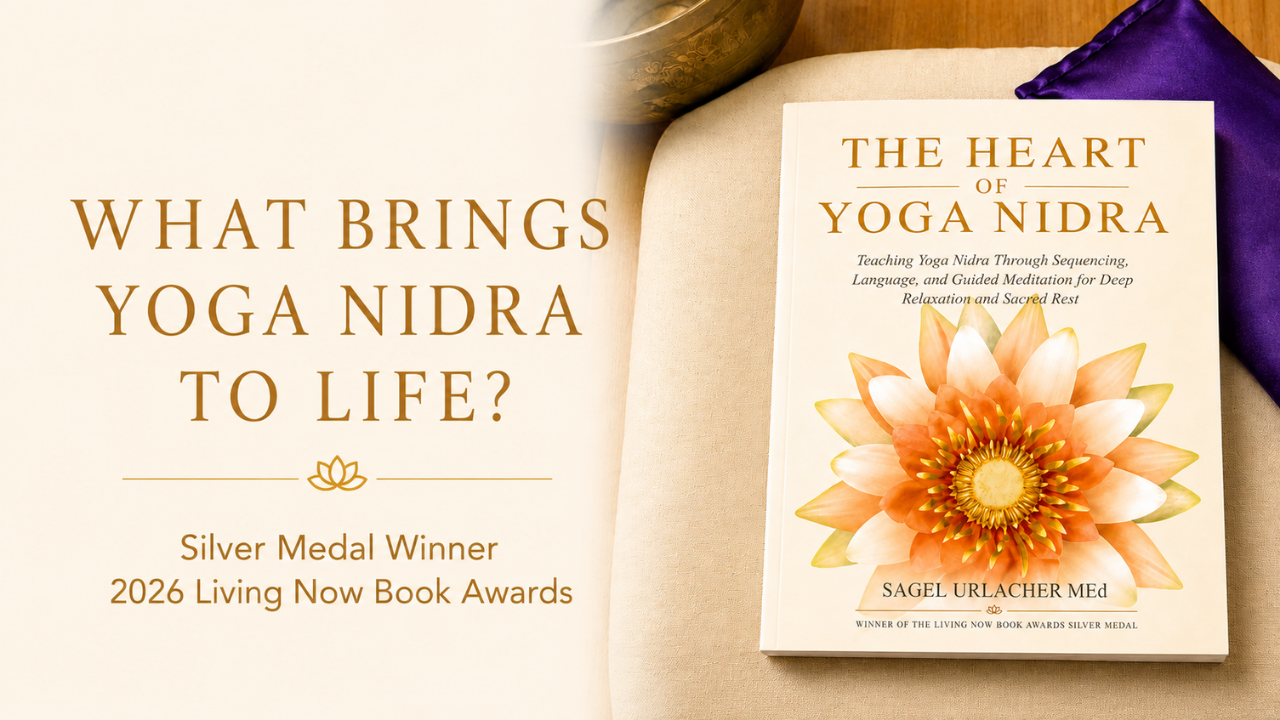
This understanding is at the heart of The Heart of Yoga Nidra.
I wrote the book for practitioners who want to develop a richer relationship with Yoga Nidra, and for teachers who want to understand not only what we offer, but why—and develop the confidence and skill to lead meaningful, transformative Yoga Nidra sessions attuned to their students’ needs.
Throughout the book, we explore a clear framework for understanding and guiding Yoga Nidra alongside the art of bringing that framework to life: how sequencing shapes the journey, how language influences the experience, how to adapt the practice and meet students where they are, and how our own practice can inform the choices we make as teachers.
Traditional yogic wisdom, modern neuroscience, practical guidance, and experiential practice come together to help us understand Yoga Nidra more fully, embody the teachings, and guide from lived experience.
“This beautifully organized guide makes the art of Yoga Nidra accessible, immediately teachable, and offers a blueprint for teaching it with authenticity.”
—Alexandra DeSiato, co-author of Teaching Yoga Beyond the Poses
I'm deeply grateful that The Heart of Yoga Nidra has been recognized with a Silver Medal in the 2026 Living Now Book Awards—and even more grateful to know that it is finding its way into personal practice, teaching, and teacher trainings.
If you're drawn to exploring Yoga Nidra with greater depth and understanding, I invite you to explore The Heart of Yoga Nidra.
Continue Exploring Yoga Nidra
The Heart of Yoga Nidra and The Book of Yoga Nidra Meditation Scripts are complementary resources for practice and teaching.
The Heart of Yoga Nidra offers an in-depth exploration of the foundations, framework, philosophy, sequencing, language, and art of guiding Yoga Nidra, with practical and experiential tools for deepening both personal practice and teaching.
The Book of Yoga Nidra Meditation Scripts offers 30 thoughtfully crafted practices for personal use and teaching, along with resources to support meaningful Yoga Nidra experiences.
Whether you are looking for a practice to guide, a deeper understanding of the practice itself, or both, each offers a different pathway into the heart of Yoga Nidra.